Thursday, August 9, 2018

Remembering the Past In Honor of Unknown Heroes


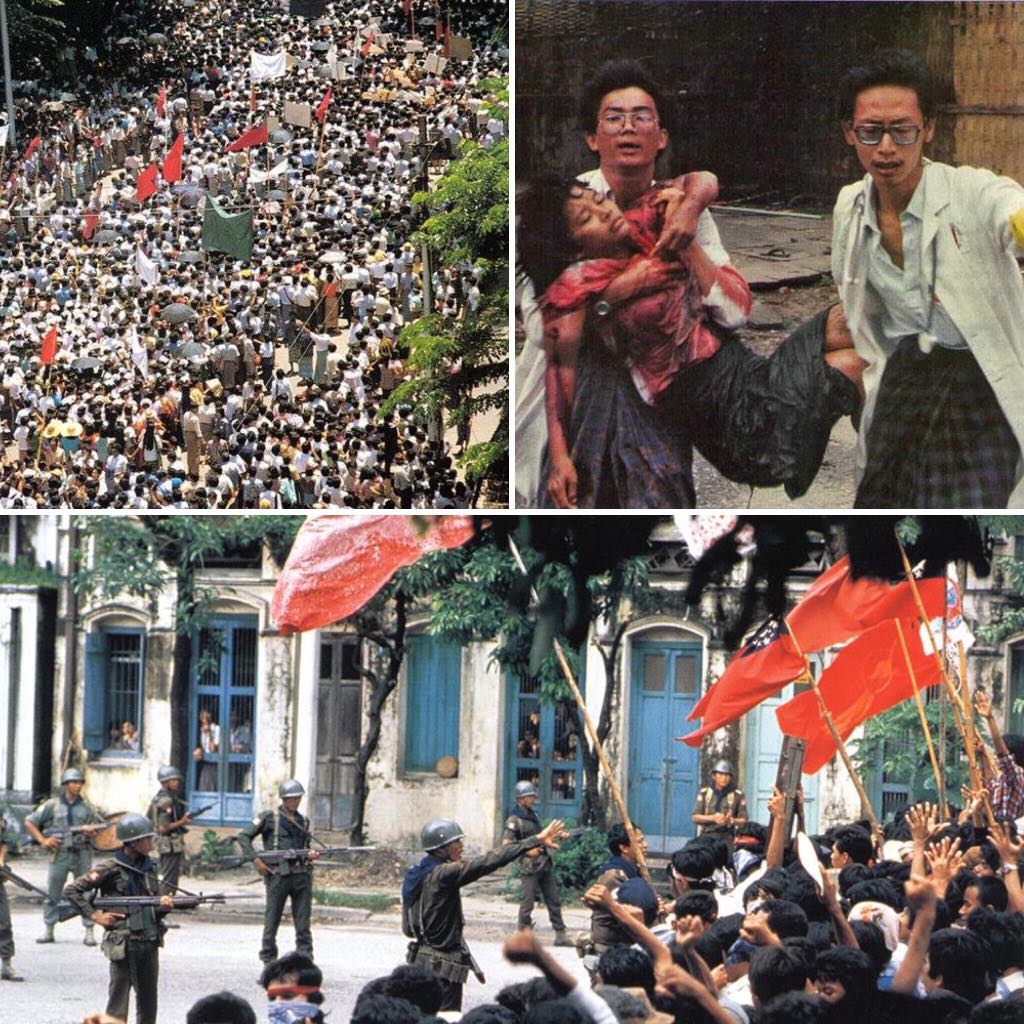
Photos from the 1988 Uprising

Remembering and honoring those unknown heroes with unshakable faith in truth, justice and freedom...

Yesterday was the 30th anniversary of the Pro-democracy Uprising in 1988 in Myanmar, which gives us this opportunity to re-engage with our past 30 years ago in order to better understand our present-day concerns and challenges, and to imagine a better future for all of us here in this country.

So I would like to take this moment to revisit the past. While there are political figures and names everyone knows and stories of all kinds about the 1988 and subsequent political struggles in our country, lacking technology combined with oppressive rule of the BSPP means that the mass nationwide movement like that could not have happened without all those people who took part and without unnamed heroes who persisted risking everything they had.

This reminded me that three years ago, I had this opportunity to help a friend who was writing a book on stories of Myanmar women - one of them she chose to write about a former political prisoner, Noble Aye. Since my friend, the writer, does not speak Burmese, I helped interpreting the interview with Ma Noble. She is in her early 40s and had been imprisoned twice for a total of over 11 years - which means that she spent a quarter of her life in prison.

She said, "Being in prison is like living a life along someone else who decides how I live. If they want to frighten us (with the imprisonment and tortures), it does not work. By putting us in prison, they destroyed our lives, our families and our future. If l look at my family, I see only broken relations, anger, sadness, poverty that was very close to begging for survival. However, my political beliefs did not change and will not change, they can never be destroyed."

Those three hours conversation/interview with Ma Noble about her life shattered me a little and also shed some light on a few questions I had about the past. I learned about her life - her involvement in the 1996 and 1998 students demonstrations and 2007 protests; how she was always followed by the military intelligence (MI); how she was arrested, and interrogated; and her life in prison.  There were moments she was shaking and her eyes were filled with tears while telling her story. I was also quite overwhelmed with tears while listening to her story.

What is really inspiring is that even though her life, her future, her family had been destroyed, there was no trace of regret in her and she still firmly believed that we should never be treated that way, we should never be imprisoned for our belief or for doing what we believe is right or exposing the truth. Her first imprisonment was due to her involvement in distributing a book about the 1996 students' demonstration, and the second was due to her participation in 2007 protests.

In her own words, "The distribution of the book was a way of telling the truth, of informing the people, of making students' testimonies collected in asylum known to the people in Myanmar."

For me personally, I was a small kid in 1988 to understand what it was all about. Yet, there are a couple of things stuck in my mind - the sound of shooting guns on the street in front of our house and the scene that a big group of unarmed young people was followed by military tanks were both very terrifying and unsettling for a small kid. For others, their brother or sister went missing; their son or daughter never came home; their friend or lover was brutally shot and killed in front of their eyes.

Looking back the past that is not so long ago in terms of history is quite interesting because we get to learn stories and narrative accounts of many ordinary people who witnessed or even participated in the events are still alive to share their accounts of what happened during that time. By referring as ordinary people, I meant that those people are not the ones in power who write the history in their favor - who craft their own narrative of the past regardless of what really happened. As Orwell put it well in 1984,"Those who control the present, control the past and those who control the past control the future". This has led to two main, yet very different, narratives of this 8888 Uprising that have shaped the subsequent fate of our country.

One of the two is that people were provoked by underground and overground terrorists and by those influenced by modern-day colonial interests; people became lawless and unruly riots spread across the country; the country was deteriorating in many aspects; eventually, when the country was on the brink of collapsing, in September 1988, the Myanmar Army had to take this holy responsibility to save the country - "in order to bring a timely halt to deteriorating conditions on all facets of the country."

The other one is that economic frustrations and general resentment towards the one-party rule of the then ruling Burma Socialist Programme Party led to series of peaceful protests by students in 1988; then the protests spread across the nation and joined by people from all walks of life. The brutal crackdowns of police killed thousands of innocent peaceful protestors. The protests were also made it appear lawless by releasing criminals who would exercise atrocities such as public beheadings and robberies of all kinds including state-owned factories. In September 1988, the military violently broke up the protests, took power, and imposed martial law. Many protestors and political activists who were not killed during the uprising were arrested and put in prisons. Their families were under surveillance of MI.

These two differing or rather contradicting narratives have shaped our present and led to where we are today. The first version was obviously imposed in many ways - through series of state-own media,  state-sponsored films, songs etc. Anyone who questioned that version of the 8888 was either arrested or under watchful eyes of MI.

Sometimes, I wonder what if we believed the first version of the 88 and did never know the truth. It is very convenient to believe it because we grew up with state media, watching state-sponsored films and songs, being taught at the state schools. When I left for the U.S. in 2003 while the country was still under the military regime, I was very much afraid to talk about politics in my country when being asked by professors at my college in Colorado. I grew up learning that discussing politics meant risking yourself to be arrested or your family to get in trouble. So it was very possible for us to never really know the true story of the 88 and its subsequent events.

Prior to learning about Noble Aye's story, it made me wonder what made it possible to learn about the truth and also what made it possible to lead to where we are today - we are at least no longer under the military rule, even though the changes have not been satisfactory.

I felt grateful for the opportunity to learn about her story, more importantly, to learn the truth. Her story would also enlighten many people like me in our country who do not know about what it is like to be a political prisoner; what it is like being confined and losing all your freedom, and your life being destroyed just for your belief and for your action to preserve or expose the truth. I found it quite irresponsible of those people who say that our democratic transition was peaceful and harmless. Saying that disregards many families like Noble Aye's who suffered so much and were destroyed. There were also many families who never got to see their husbands, daughters or sons again.

People like Noble Aye are not famous nor popular but their strength and their unshakable faith in truth, justice and freedom, along with their persistent actions to live up to that faith, collectively challenged the imposed narrative, crafted by those in power, and eventually challenged their illegitimate rule over the country. It is because of their unseen struggles, and unheard but very strong and brave voices, we have been able to reach where we are today even though much is still needed to be done for a better and brighter future we all want to reach.

Saturday, February 10, 2018

On Pursuit of Happiness vs. Pursuit of Meaning


The distinction between happiness and meaningfulness has a long history back to thousands of years in philosophy and religions. In short, a pursuit of happiness is seeking to live by pleasures, in other words, by taking things from outside to satisfy one’s senses. A pursuit of meaning, on the other hand, is seeking to live for something bigger than the ‘self’ - which could be our family, our work, or any other divine thing or Nature. 

I do not know enough philosophical references on happiness vs. meaning so I would like to express it using my own personal experience. I grew up in Monywa, a city in the middle of Myanmar. It is a relatively big city but compared to Yangon, it could be considered quite rural. On a funny note, a friend of mine asked me recently if I went to "ILBC" in Monywa since I studied in the U.S. and now fluent in English. Back in those days, there was no such private school in Monywa. I did not have any exposure to speaking or learning English besides the public school textbooks. 

I did not enjoy school much even though I did quite well - I was on one of the top 3 most of my years in basic education. The teachers or my classmates did not like it when I asked questions. I tried to understand and to make sense of what I read in textbooks but it was nearly impossible. I was in high school in Monywa, when I first learned about the education in the U.S. from an information section by Sayar U Tin Maung Than, who recently came back after studying at Harvard Kennedy School.

After I finished 10th grade exams, after series of arguments with my father who was against my desire to study abroad because I was a young girl, I left Monywa for Yangon to prepare myself to study abroad. I completely dropped going to the medical school in Mandalay. Long story short, I got into one of the private liberal arts in the U.S with a full scholarship for 4 yrs. My family was in no position to fund for my education otherwise.

And my plan was supposed to come back home after four years and to contribute something good to the society back home with the education I would get from the U.S. At least, that was what my parents wanted. For me, I just wanted to be outside of home to be free and independent, both intellectually and personally. 

The year I graduated from Colorado College, thinking back now, was a turning point - or rather I was at an intersection between pursuing a life for myself or a life for others. To be honest, I was quite lost. I did not even know clearly what I was trying to choose or what I wanted to do. So when you don’t know what you want or don’t know who you are, you become less in control of your life. You mostly get into the “default” setting, meaning you just try to follow a life as it has been prescribed by the society you are in.

To make it long story short, that default setting went on for another six years in New York. But the narrative I said in my head goes like this “people should be taking care of themselves. If you are doing good for yourself, you are “automatically’’ contributing good to the society.” I was completely just living for myself and myself alone. Well, I was not a bad or mean person - I still cared a lot for my friends but in a larger part, I believed that I should just live a “happy” life. I worked at a small company - even though work did not mean anything to me but I still worked very hard - there was a small part of me hidden inside that wanted to learn, grow and also help others around.

But I felt like I was working so that I could enjoy life. New York has endless stimulations to keep you busy. During that time, I went back to a graduate school for Accounting. Because after liberal arts education, I felt I needed to pick up some very specific skills to make use of myself at a work place. That was pretty much all my 20s.

So my 20s were spent pursuing a happy life and living for myself. Then when I hit 30, it hit me quite badly - I felt so bad that I had not done much and felt that I wasted most of my 20s. I needed urgently to find myself again and to be back in control of my life. And in one of the business classes I took in my last semester at the grad school, one thing got stuck in my mind, “in order to change something, you need to get back to the core.” After series of questioning myself and talking with my brother, to whom I’m most grateful for helping me through that existential crisis, I decided to move back to my home country. In order to find myself, I needed to get back to the core, where I started, and to be closer to my family and in my home country.

Since I have decided to pursue a meaningful life - to live for more than just for myself, I have been through two major processes - learning and giving. Personally, I have been learning rigorously about myself, about others and about things that I was very curious about- through asking questions to myself, reading, watching documentaries, listening to others, meditating. Professionally, I have committed myself to help and serve others around me, and to give back with the best of my abilities and skills I have.

This past four or five years have been a quite satisfying endeavor for me - it has not been easy at all like when I was just pursuing a happy life. There have been stresses and struggles involved but I feel now that I am a much happier person. 

I’ve recently realized that, besides learning and giving, there is another difficult step in the pursuit of meaning  a spiritual part  it is about love. I still do not quite understand what it really means to love. In general, I think we can learn to love by being more open to life, appreciating people and things, even little things, accepting and content with what we have.

To me as mentioned above, a meaningful life —a life of learning, giving and loving — is more enjoyable and satisfying. We have this capacity, intelligence and compassion to live for more than ourselves. Through this life long journey in pursuit of meaning, we may be able to expand ourselves intellectually, emotionally and spiritually.

Wednesday, August 10, 2016

On Eliminating Our Blind Spots


"The point is to try to eliminate your blind spots — the things that keep us from grasping the bigger picture. And look, even though I grew up in this neighbourhood — in this incredible, multicultural neighbourhood that was a little rough at that time — I find myself here before you as an American, white, male movie star. I don’t have a clue where my blind spots begin and end. But looking at the world as it is, and engaging with it, is the first step toward finding our blind spots. And that’s when we can really start to understand ourselves better ... and begin to solve some problems." - Matt Damon, MIT Commencement Speech 2016

A few days ago, I was having a conversation with my parents trying to understand how we grew up, our experience and ideas around us have shaped who we have become as adults. Even within the same family, I realised how differently my mother and I grew up as a young child and teenager.

I hardly had any clue about a life my mother had, as much as my mother could only have little idea about experience I've gone through as a girl from Monywa, Colorado to New York and then back in Myanmar.

My mother is a very strong woman, my role model, who always guides us with her great values. She grew up in a poor family, and as a second eldest of 9 siblings, she grew up babysitting all her younger siblings, and helping my grandmother in all household chores. She eventually had to drop out of school at 9th grade as all the family responsibilities and also financial situation did not afford her to continue school. 

I grew up in a lower middle-class household - my father was a junior civil servant when I was a kid. Both my brother and I went to a primary school in a poor neighbourhood of Monywa, a town in the middle of Myanmar. We had daily allowance of 1 or 2 kyats in primary school and only got to eat shrimps once a year. When I started dreaming back in high school about studying abroad, my friends thought I was out of my mind to dare to think of something "impossible". My father was also strongly against the idea because a young girl was supposed to be under his protection, and he also thought it was insane to forgo the medical school and try something completely uncertain -- winning a full scholarship from one of the top liberal arts colleges in the U.S. Anyway, to make the long story short, against all odds, I made it all the way!

Studying in Colorado for 4 years, and living in New York for a few years, I'd become complacent. I had no clue where my blind spots begin and end. I thought I had a pretty good idea about life and the world. Eventually, I had to painfully embrace the fact that I had no clue about who I was and what I wanted to do with my life. So, taking all the possible risks, I moved back to my home country nearly 3 years ago. In the beginning, I was in a series of shocks - I was in pain to know how clueless and ignorant I was for all those years. 

Through my own pain, I had a little bit of idea about how painful it must be to be rid of opportunities and resources to better yourself and improve your life chances, to feel uncertain and hopeless about tomorrow, and to be victimised for just being poor. I had a lot of questions about "what ifs" - what if I grew up in a poorer household, what if my parents made wrong choices about their life, what if I did not even have enough resources to try to get into a liberal arts college in the U.S. 

Since I moved back 3 years ago, I've been in this constant process of rocking the boat, both inward and outward, through reading, traveling, meditating, listening to others and watching documentaries. I've been trying to shake up all my beliefs and everything I held dear to my heart and mind. I've kept trying to understand alternative points of view and information even if those are so against my own beliefs. I've learnt to approach anything with healthy skepticism. 

Even then, I know that I'm still far from getting closer to the truth because I still have my fair share of blind spots -- biases, prejudices and intellectual limitations. In the process, I'm also aware that I'm subject to arrogance and complacency every now and then. 

Eliminating our blind spots, in the process of actively searching and learning, is a life-long endeavour. I hope I never stop learning and actively engaging myself with life and the world before me.

Saturday, April 16, 2016

When You Believe in Choice

Labastide-Esparbairenque, France

“Belief, like fear or love, is a force to be understood as we understand the theory of relativity and principals of uncertainty. Phenomena that determine the course of our lives. Yesterday, my life was headed in one direction. Today, it is headed in another. Yesterday, I believe I would never have done what I did today. These forces that often remake time and space, that can shape and alter who we imagine ourselves to be, begin long before we are born and continue after we perish. Our lives and our choices, like quantum trajectories, are understood moment to moment. That each point of intersection, each encounter, suggest a new potential direction. "—David Mitchell, Cloud Atlas
I love Wachowski brothers' moviesMatrix triology,V for Vendentta and Cloud Atlas. Their movies' recurring themes are a hero journey, and how the hero makes choices along that journeyusually the hero starts out with being completely ignorant and unaware of the world around or rather confused, at some point, he or she wakes up, becomes aware and starts fighting for things like justice, freedom and overall ignorance.

I see life as a long journeymaybe it is not as fascinating as in Wachowski's movies. Each and every choice we make, small and big, leads us to a new path. First and foremost, choosing which direction we want to go in this journey is very important.

Looking back seeing choices and decisions I had made, I see that sometimes I made choices, without thinking much, either out of social pressure or trying to meet existing social standards but there were also times when I made deliberate choices based on certain beliefs or strong desire to achieve something. Either deliberate or automatic, these choices have become the paths that form where I am heading in this journey.

I have made a fair share of mistakes and unwise choices in my life, either out of sheer ignorance or emotional turbulence. There are also times when I make good and wise choices based on clarity on possible consequences and understanding the depth of my own pain and problems or just out of compassion or kindness for myself or another being.

About three years ago, I was completely lost and going through an existential crisis. My therapist and counselor, who helped me through it, was my brother. He was very compassionate, and emotionally available enough to give me guidance and helped me understand my struggle and myself. I am forever grateful to him for that.

When I expressed him how thankful I was, he said "No, I did not help you. You helped yourself. I've become the person I am today because of your guidance and help when I was young and ignorant."

I did not even think that I had helped him. It was just out of "love and kindness" that I gave him certain guidance in the past. Consequently, I am benefitting from it, but then he could have chosen to ignore and not help me.

Recently, I've been struggling or I've been confused about certain things and my recent choices. I've been feeling that life is just meaningless and it is pointless to do anything meaningful. Whenever I get online and read news, I feel hopeless because I am constantly being fed up with the news how corporations are destroying quality of human lives, wrecking the environment, governments facilitating all these corporations to rob us (and hiding their money offshore), media brainwashing us to hate certain groups of people or blaming their selected situations.

Just to clear my contaminated mind and to have a break from the civilisation, I'd made a choice to go on a retreat Writers and Artists Retreat in Southern France. I told them that I am not a writer, I just wanted to read, think deeply and just simply retreat.

Being surrounded by this beautiful nature, not contaminated by the civilisation outside, and good hearts and kindness of the writers in the retreat, I am feeling hopeful and having faith in humanity once again. I did not fully understand why I chose to come here but I realized now that this is exactly what I needed  to feel hopeful again.

Believing in choice, instead of fate, is not easy. It is difficult and it often feels like a burden because we are responsible for our choices. Our choices shape who we are, which direction we are going in this life journey and how we impact those around us and the world.

I may not be able to make wise choices every time.  But, I will always try to choose love, hope, truth, courage and justice. And again and again.

Saturday, February 13, 2016

What It Means to Really Love Someone

"Love is about bottomless empathy, born out of the heart's revelation that another person is every bit as real as your are...Trying to love all of humanity may be a worthy endeavour...Whereas, to love a specific person, and to identify with his or her struggles and joys as if they were your own, you have to surrender some of your self."  - Liking is for cowards. Go for what hurts.


When I was only in pre-school, during a scene in a movie in which a boy and a girl were showing some romantic gestures, I commented by saying, "Oh they got together!" My mom was quite upset that how little person like me could know such things.

So that shows that it is in our human nature to be quite aware of romantic connection and love since very early in life. But, as I grew older, I learned that I did not know anything about love at all. All I know about love is quite shaped by our society and popular culture.

Whether you are man or woman, old or young, whichever society you grew up, or what religion you belong to, you, as a human being, want to love and be loved. It is a basic human need. But, what does it really mean to really love someone?  I'm going to share what I thought of love over the course of my live in different phases - from teenage to my adulthood now.

Love is a beautiful fairytale.

This is quite plain and simple. As a young girl in late teens, I thought love starts out with a boy and a girl liking each other so much, then falling in love and then getting married and living happily ever after.

Love is dealing with an annoying human being.

I really enjoyed all the fun part of beginning of any courting. It is quite fun to be pursued and chased by someone. But then, there came to a point, all my fairytale romantic fantasies shattered as harsh realities hit. I was still quite young, early to mid twenties, and packed with insecurities myself. I fell in love with fantasies and an idea of a perfect boyfriend. But I lacked the maturity and understanding of what it means to be really close to someone in his all imperfections after the honeymoon phase. It was all about endless fights and verbal abuses in every way. After three years, I decided to end it. For those three years, I really thought love sucked and it was just quite annoying. One thing I learned from it was that I want to be treated with respect and kindness. It is a basic need and anyone who is not that, I would not even bother to talk to.

Love is a goal to accomplish with certain expected results.

I dated someone right after my three-year relationship. That did not last long but it was quite fun experience - I got to enjoy the fun honeymoon phase of courting.  We did not really have a kind of connection that could hold us together past the honeymoon phase.

I stayed single for a couple of years. Partly because New York City is such a great place to be single. You meet new people all the time.You flirt here and there, and then move on and look for what is the next best thing. Then eventually through all those socialising and friends' parties, I met someone really amazing. It was all fun and exciting as it is always with beginning of any relationship.  I felt really connected with him - we made each other laugh all the time. I started learning that no one is perfect - I accepted that even that amazing human being I fell in love would not be perfect.

However, over the course of the relationship, I started to focus more on signs and indicators of loving affections from him than really enjoying each and every moment with him. What he does or does not do became more of a big deal than our time spent together and learning about each other. I was really focused on the results than the process of deeply connecting with him. As he was a really great man and things had gone well, I wanted it to be in a "successful" relationship, that would fulfil, again, all my romantic fantasies. ( But I never thought of marrying him or anyone in my life for that matter.)  It was obviously no longer fun anymore. I am sure that he went through a series of doubts and I was even more insecure. Eventually, it led to a breakup.

Love is pain so I must avoid it.

I was in a tremendous amount of pain. At the same time, I made a very big decision - a decision to move back to my home country. Well, I did not move back because of my heartbreak. But I did think that big change like that somehow would help me mend my heart. It took me a very long time - more than a year to recover from it. While mending my heart, I found a job that I'm more and more falling in love with day by day. I've been focusing on learning about myself and on my professional development. For a long time, I felt that love is a pain so I must avoid it at all costs and I emotionally shut myself down.

Love is a courage to face the fear of rejection.

After I recovered from that painful heartbreak, I was thinking that "Maybe I don't "need" someone to love or be loved. Maybe I have been socially conditioned to think that I need love to justify my worthiness as a human being." In many ways, I am a very self-sufficient person and professionally very capable, or at least I want to think so. So why would I bother to take all the pain and emotional inconvenience of being with someone? Then I realised that I was lying to myself. It is quite comforting to reject something before it rejects you because being truly known makes you vulnerable and potentially be rejected.

So I realised that I was just being a coward - I did not want to take the risk of being rejected because it is really terrifying. I then learned that love is a courage to face that fear of rejection by being truly known and letting yourself be vulnerable.

Real sustainable love is a process and a choice...

After giving a lot of thoughts and feelings to understand what people in loving sustainable relationships go through and analysing my own experience with relationships, I am slowly learning that it is quite easy to fall in love with a fantasy. We all love the "idea" of falling in love with someone and fantasise about all the excitements and happy moments.  We are often more obsessed with the end results than enjoying the moment and bothering to get to know someone.

I think that the real sustainable lasting love is a process - a process of understanding someone, with all the kindness, generosity and bottomless empathy, or at least an attempt to understand someone, and at the same time, surrendering your pride and exposing yourself to be known. And during the process, you make a choice to be in that process again and again, regardless of fear and doubt that the other person might not choose you.


Thursday, August 27, 2015

What I learned from making mistakes


I've been feeling quite proud and a bit overconfident because I thought that I was now mature and I took responsibilities for my mistakes. I was no longer afraid to apologize first unlike I was in the not-so-far past. 

But I was wrong about myself.

I accept at the superficial level that I am not perfect and I could make mistakes. But, in reality, it is not always easy to accept that I have limitations. Especially it is harder when things have been going well on my favor. And that's when I lose sight of myself.

About a week ago, I was blamed by  a very important client for failure to communicate an important technical aspect of project. In normal circumstances, I could have been able to handle it like a mature responsible person. But I was not. I felt trapped and felt like a 5 year old kid who did something wrong. And worst, I did act like a 5 year old kid—I tried to escape from the blame so I gave excuses that it was not my fault.

I felt terrible after that because I’m in charge of the project and not in that sort of position to not take responsibilities for my own mistake. Even after I fixed the situation right away and did a damage control, I was in a big emotional trauma. I could not forgive myself and could not sleep the whole night.

A week after, I made another mistake again—I failed to communicate to my boss, chief technical officer, about another important technical aspect of the same project. A couple of people including the CTO were disappointed with me. I felt terrible again but this time, I had recovered quickly. I did not dwell on my mistake so long. I apologized to the team very quickly and I admitted that it was my fault.

On my way back home, I thought about why I’ve been making big mistakes twice in a row within a week. Even though I apologized quickly in the second time, I was feeling very uneasy. Then I realized that I learned incredible lessons from these mistakes. Within one week, I feel that I've become grown and personally expanded.

Here is what I learned:

1.     I was reminded of my own limitations.

When things were going well, I could not see myself where I actually was and where I still needed to improve. Only after I made mistakes, did I understand about my own limitations. Facing our own weaknesses and limitations could be quite scary, but without facing them and accepting them, we cannot expand and grow as a person. I will never be a perfect human being since perfection does not exist. I think that one of the most amazing things about life is learning about our own imperfections and continuously trying to fix them in order to become a better person. I think it is an incredible process and a wonderful journey!

2.     Importance of forgiveness

There are two ways for us to feel pain. One is caused by external events or people, which is out of our control. The other is caused by our own reaction to that external pain, in other words, our self-inflicted pain. It was already painful to learn about my own limitations. I made it worse by feeling really guilty about it. I could not forgive myself for several hours. Then I really made an effort to forgive myself. I learned how important it is for us to be kind and forgiving to ourselves in order to move forward.

3.     I have been out of my comfort zone!

After going through guilt, self-disappointment and apologies to people, I discovered that I’ve been out of my comfort zone. When you are doing usual things that you are familiar with or working within your limits, you do not make mistakes. I’ve realized that I’ve been doing a lot more taking a lot more responsibilities and working on much more complex projects. That was one of the “uh-ha” moment and I felt grateful to myself for questioning and also grateful for all the opportunities to get me out of my comfort zone so that I can grow.

Wednesday, July 29, 2015

What it means to really care to talk to someone


Most of the times, I feel that I need to do something big or to become someone in order to be able to do something meaningful or something that matters. But, it makes me really surprised sometimes how very tiny things I do could make someone's day better. 

Lately, I'd been feeling super stressed at worktoo many projects on my plate with many competing timelines. I got too stressed that I wanted to take a long break to do 3-6 months of hiking a long distance trail like Appalachian trail or PCT; or leave all these behind and become a recluse or a hippie. I was thinking, "What's the point of all this? We are all screwed anyway, right? I'm not gonna be able to do anything to help anyone, at least not in this world." 

Very luckily for me, in the past two days, I got to leave the office! I was out with an international consultant in a community outside of Yangon to pre-test survey tools. To be able to be out of office for two full days, I worked 13 hours the day before so that I did not have to worry about the deadlines for some other deliverables. 

It is one thing to see tabulated data, and read transcripts of interviews and focus group discussions but it is a whole different story when you really talk to people and get to interact with them in a community. Many of our social research projects are carried out nationwide or in many different parts of the country. It is quite fascinating to learn so much about all these different communities—their diverse ways of life and many different practical issues at community level. 

In the past two days out in the field, all these people we interviewed were super amazing. They were so hospitable to us. They were so generous with their time and they just really wanted to treat us so well regardless of how poor they are. (That is, a family of five, a husband and wife with 3 young children, live on approximately $3 a day.) The house we visited has no furniture. She laid down a mat for us, and asked someone to go buy two bottles of juice for us from a nearby shop. 

They were so happy that we cared to know about their life as we asked so many questions. No matter how humble we were and how down-to-earth we were, our interviewee knew for sure that we came from a very different socio-economic background than hers. Before we took off, the woman said, "It's so lucky that you came here (to her house.) There is no way for me to come across and to be able to interact with such well-educated people like you." 

All we did was stealing 2.5 hours of her time for the day and she was grateful we cared to know about her and her family. A few of her relatives heard that she got guests in her house so they stopped by to see us. We also interviewed a school head of a primary school, who treated us with lunch she cooked and brought for us. She was informed from the township education office that we were visiting her school. 

Even though these people would be considered materially poor, they are rich in love and kindness. They are so happy and content with what they have—they gave me hope and faith in humanity once again. 

Both my colleague and I were so grateful to these people and their heart-warming generosity. In the past two days, on our way back in the car, two of us had so much fun talking about our adventures in the U.S. visiting some beautiful national parks, about people who helped us in our life in great ways, about people who inspire us, about books we read and about what we want to do with our lives.

When we are really open and care to talk to someone or anyone, we can really have meaningful connections with anyone. Isn't it so wonderful?